
Nature Machine: 6th Tamworth Textile Triennial
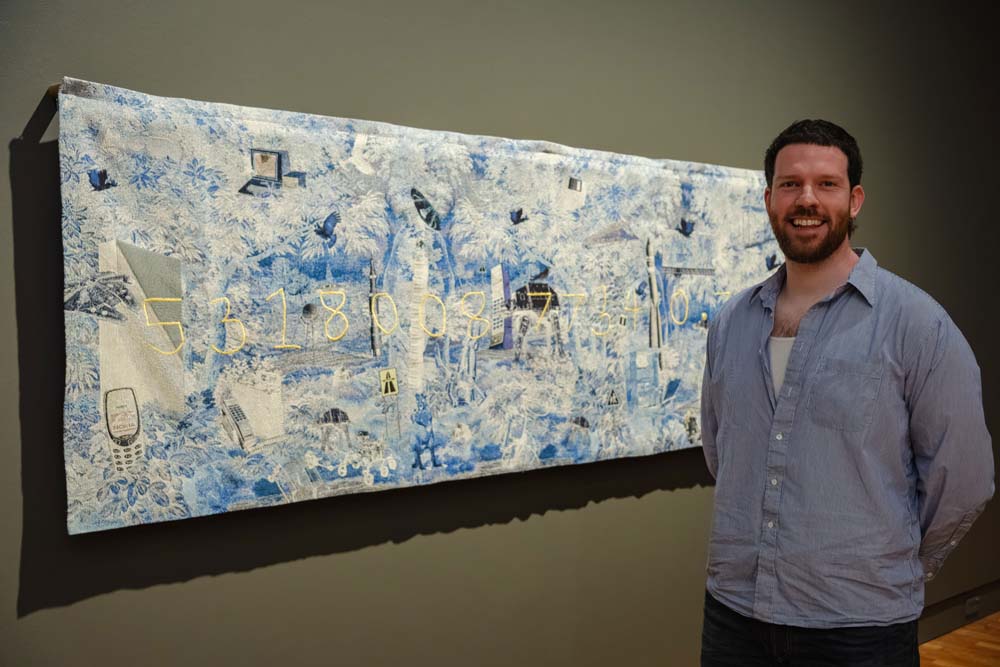
Nature Machine: Tamworth Textile Triennial, 2026
Image courtesy Tamworth Regional Gallery
Jackson Farley
19 Sep 2026 - 1 Nov 2029
Tamworth Regional Gallery is proud to present Nature Machine: The 6th Tamworth Textile Triennial, a major national exhibition that showcases the vision and innovation of contemporary textile practice across Australia. Curated by Blake Griffiths, Nature Machine brings together leading and emerging textile artists whose practices reflect the profound and often complex ways makers grapple with the complex relationship between hand, body and machine. With boldness and care, the exhibition asks: how can artists create in ways that sustain, rather than deplete, the materials and ecologies they work with? The artists of Nature Machine experiment with growing, harvesting, recycling, and reimagining textile resources, while others turn to the virtual, embracing artificial intelligence and machine production to explore and challenge the changing role of textiles in a technological age.
From permaculture to programming, each artist demonstrates how making can become a form of ecological stewardship; their material innovations and technical mastery revealing not only the ingenuity of Australian textile practice today but also, the deep responsibility artists feel toward the environments that sustain them. The exhibition celebrates the diverse ways artists are responding to urgent environmental concerns, protecting traditions, revaluing craft knowledge, and proposing new ways of living with, and making from, the world around us.
Artists include:
Abdullah M. I. Syed | Alycia Bennett | Anita Johnson | Cara Johnson | Ellen Ferrier | Jackson Farley | Jacky Cheng | Jacqueline Stojanovic | Janette Murrungun | Jennifer Robertson | Joseph E Burgess | Juanella Donovan | Juanita McLauchlan | Lauren Kerjan | Lucia Dohrmann | Margaret Woodward & Justy Phillips | Rebecca Mayo | Sharon Peoples.
Created during his residency at the Australian Tapestry Workshop in 2026, the triennial features a new work by Jackson Farley, 5318008 7734 0.7734, 2026. When a machine begins to operate outside its intended purpose, a new genesis begins. This work imagines that moment: the speculative birth of artificial intelligence, emerging through pattern and image. Woven as a Jacquard tapestry (one of the earliest programmable machines) the work traces a lineage from textile production to contemporary computation. Through punched cards and encoded pattern, the loom translated information into image, establishing a foundation for machine intelligence.
A Flemish pastoral landscape is interrupted – almost poxed, with early technological objects: first computers, satellites, mechanical devices and fragments of digital culture. These artefacts sit within the scene like seeds or intrusions, marking the points at which machines begin to register, process and remake the world. Alongside them, traces of Australian vernacular imagery emerge as distortions: road signs, animals and consumer objects appearing as if misremembered or improperly learned. In this imagined genesis, the machine does not inherit a neutral world, but assembles one from its training data, hallucinating a version of place that feels uncannily, and inexplicably, Australian.
The title, 5318008 7734 0.7734, references calculator language which, when inverted, reads hello / hell / boobies. Once a playful form of early human–machine interaction, these numbers become the work’s opening utterance: the first words spoken in a new technological genesis.